

Bikepackia
EuroVelo · Austria

Ride the Danube and the Alps.

Six signed EuroVelos cross Austria — the flat Donauradweg down the Danube, the Sun Route over the Tauern to Italy, the Baltic–Adriatic through Vienna and Styria, the Iron Curtain Trail along the border, the new Waters of Central Europe and the short Rheinradweg. All ride Austria's named cycle network. Explore them, then send one straight to the planner.

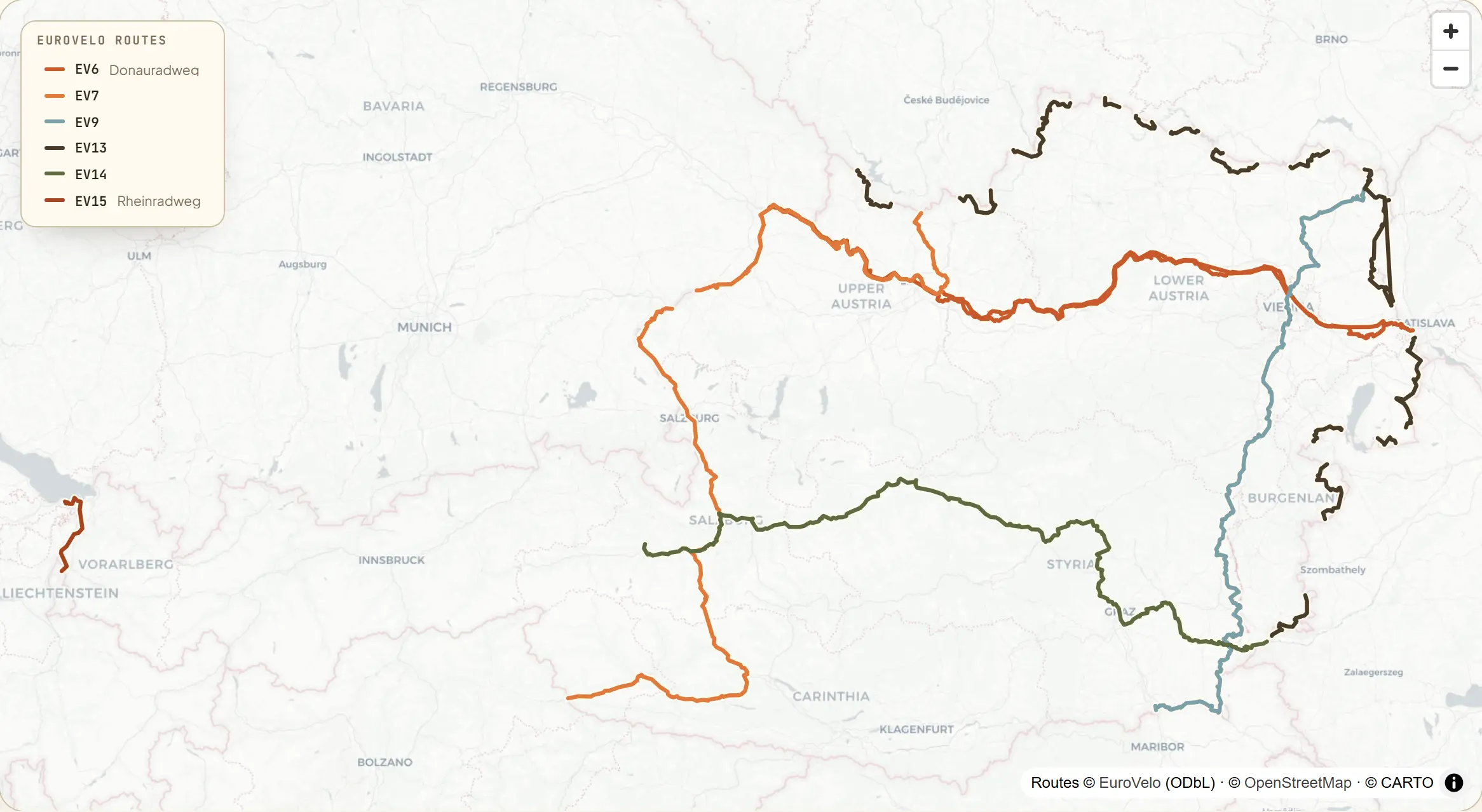
Map of Austria with six signed EuroVelo routes — the Donauradweg (EV6) down the Danube from Passau to Hainburg, the Sun Route (EV7) on the long diagonal from the Czech border to the Italian border, the Baltic–Adriatic (EV9) through Vienna to Slovenia, the Iron Curtain Trail (EV13) along the northern and eastern border, the Waters of Central Europe (EV14) from Zell am See to Hungary, and the short Rheinradweg (EV15) in Vorarlberg.
6
national routes
~2,350 km
EuroVelo signed
6
named cycle routes
Why Austria

Six EuroVelos on the named cycle network.

Austria has no numbered national grid — instead a mature layer of named routes the EuroVelos ride: the Donauradweg, Tauernradweg, Alpe-Adria-Radweg, Murradweg, Ennsradweg and Rheinradweg. The traffic-free backbone runs flat river towpaths — Danube, Mur, Enns, Inn — plus Alpine valley paths, with railway stations and Bett+Bike beds mapped on every route. The Donauradweg alone is among Europe's most-ridden river rides, past the Hohe Tauern, the Wachau abbeys, Vienna and the Styrian wine country.

The mapHover a route to trace it

Six EuroVelos across Austria.

Austria's six signed EuroVelos, clipped from the official GPX tracks. Hover a line or its legend entry to trace it — the Donauradweg down the Danube, the Sun Route on the Alpine diagonal, the Baltic–Adriatic through Vienna and Styria, the Iron Curtain Trail along the border, the Waters of Central Europe to Hungary and the short Rheinradweg — then tap through to the route.

Interactive map loads as you scroll
National & regional infoBackground, not booking

The bodies behind the network.

Austria's cycle network is run by Radlobby's EuroVelo coordination centre, with the national tourism and route-marketing bodies behind the named routes every EuroVelo maps onto. It's here for context and credibility. No need to leave to plan: your route and every place to stay come together in the Bikepackia planner.

The routesTap a card to learn more

Six ways across Austria.

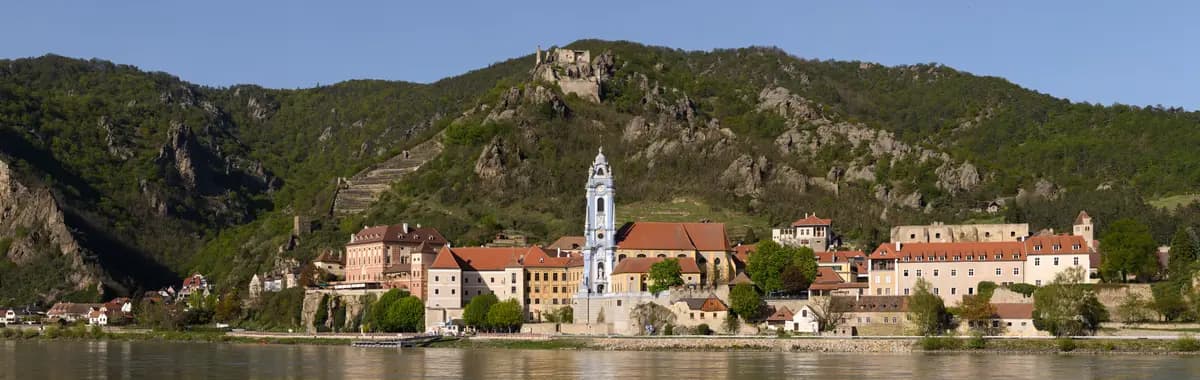
Dürnstein in the Wachau on the Danube
Photo: Uoaei1 / Wikimedia Commons (CC BY-SA 4.0)

Atlantic – Black Sea

DonauradwegPASSAUHAINBURG

Austria's best-loved ride and one of Europe's most popular river tours — the Donauradweg, flat and fully path-based the whole way. From Passau on the German border it follows the Danube through the Schlögen loop to Linz, past Melk abbey and the UNESCO Wachau vineyards (Dürnstein, Krems) into Vienna, then on to Hainburg and the Slovak border near Bratislava. Easy: it runs almost exclusively on cycle paths, the most mature corridor in the country. EuroVelo states ~380 km across Austria.

380 km6–8 daysEasy
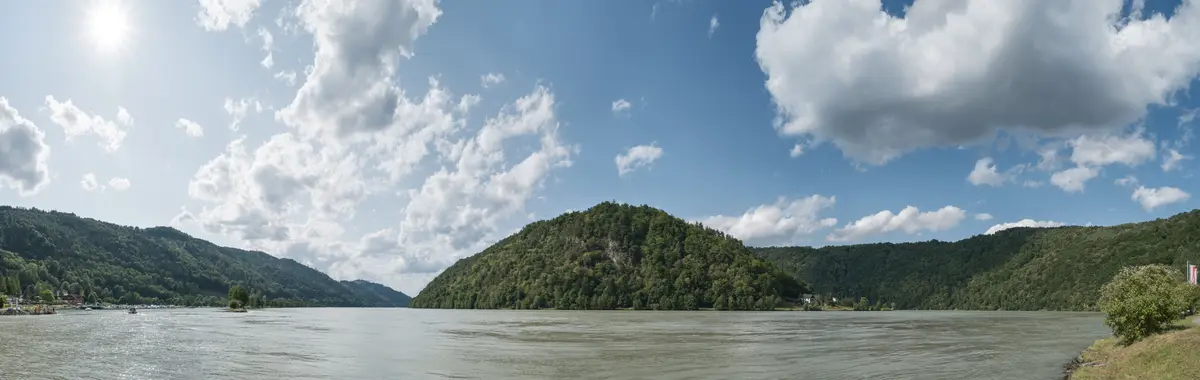
The Schlögen Danube loop in Upper Austria
Photo: Giorgio Galeotti / Wikimedia Commons (CC BY-SA 4.0)

Sun Route

RADINGSILLIAN

Austria's long NE→SW diagonal and the toughest of the six — a multi-corridor stitch-up of named paths. From Rading on the Czech border it crosses the Mühlviertel down to the Danube at Linz and the Schlögen loop, then climbs the Inn to Salzburg, the Tauernradweg and the Alpe-Adria-Radweg over the Hohe Tauern and the Gastein valley to Sillian, near the Italian border at San Candido. Hard: flat Danube north, then genuinely Alpine south. Upper Austria is the weak spot — the EuroVelo page flags it as not yet EuroVelo-signed. About 550 km across Austria.

550 km9–12 daysHard
Bad Radkersburg, Styria's spa town on EuroVelo 9
Photo: Karl Gruber / Wikimedia Commons (CC BY-SA 3.0 AT)

Baltic – Adriatic

REINTALSPIELFELD

One of the shorter EuroVelos, stitching the Weinviertel, thermal-spa and Styrian wine paths with a Mur leg. From Reintal on the Czech border it runs the Weinviertel vineyards to Vienna and the Ringstraße, then the Thermenregion around Baden, eastern Styria and the spa town of Bad Radkersburg, before turning south at Spielfeld for the Slovenian border toward Maribor. Moderate: largely gentle Vienna-basin and Styrian country with rolling vineyard sections, but no Alpine climbs. eurovelo.at gives 480 km across Austria.

480 km8–12 daysModerate
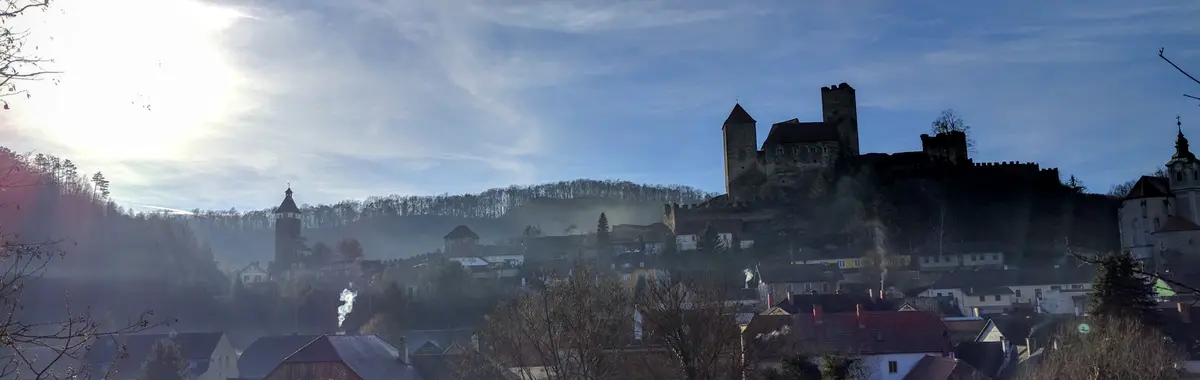
Hardegg castle above the Thaya, on the Czech border
Photo: Toben / Wikimedia Commons (CC BY-SA 4.0)

Iron Curtain Trail

GMÜNDHUNGARIAN BORDER

The hilly border arc along Austria's whole north and east edge — the former Iron Curtain and its Green Belt. From Gmünd on the Czech border the continuously signed section runs through the Waldviertel and Weinviertel — Weitra, Hardegg, Retz — to the March–Thaya floodplains, the Bridge of Freedom and the Schloss Hof / Devín corner near Bratislava, then the Neusiedler See and Andau to the Hungarian border near Szentgotthárd. Hard: the hilly Waldviertel topography needs good fitness (+2,390 m), and parts are unsigned. About 460 km across Austria.

460 km9–13 daysHard
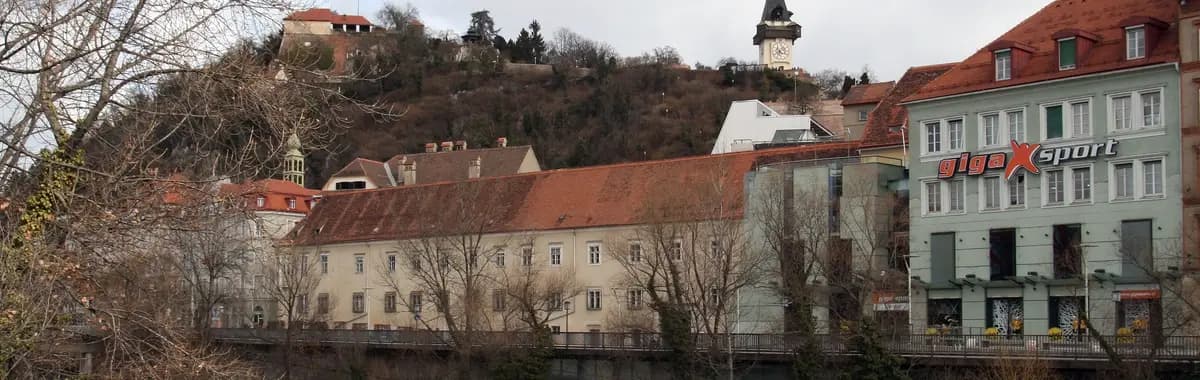
Graz Schlossberg over the Mur
Photo: Manfred Werner – Tsui / Wikimedia Commons (CC BY-SA 3.0)

Waters of Central Europe

ZELL AM SEEHUNGARIAN BORDER

The network's newest route, and the first in any Bikepackia hub — a chain of river valleys. From Alpine Zell am See it descends the Tauernradweg, then the Ennsradweg past Leoben and Bruck an der Mur, the Murradweg through UNESCO Graz, and the Oststeiermark and Raabtal paths to the Hungarian border near Szentgotthárd (continuing toward Lake Balaton and Budapest beyond). Moderate: an Alpine start at the Tauern, then long, mostly downhill river valleys — rivers, lakes and spas all the way. eurovelo.at gives 430 km across Austria.

430 km7–10 daysModerate
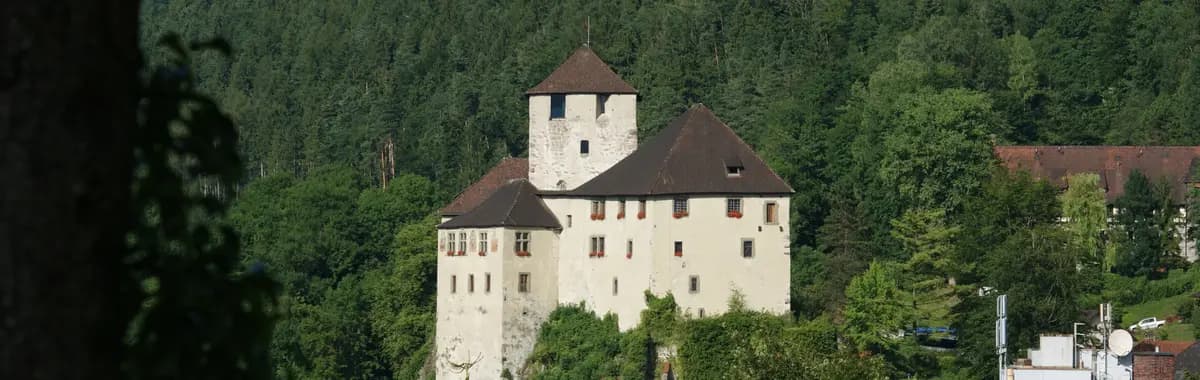
Feldkirch and the Schattenburg, Vorarlberg
Photo: Asurnipal / Wikimedia Commons (CC BY-SA 4.0)

Rhine Cycle Route

RheinradwegFELDKIRCHHÖCHST

The shortest Austrian EuroVelo — a flat one-day Rhine hop across Vorarlberg, added to the network in 2025. From Egelsee near Feldkirch on the Liechtenstein border it follows the Old Rhine (Alter Rhein) through Lustenau and the Rhine-delta reed beds to Brugger Loch and Höchst, reconnecting to Switzerland at Lake Constance. Easy: about 50 km on the flat valley floor — a single day, and a clean link between the Liechtenstein and Swiss sections of the Rheinradweg.

50 km1 daysEasy
Before you rideAustria, the practical bits

What every bikepacker asks about Austria.

Is wild camping allowed in Austria?

Generally no — and the rules are complicated, varying by Land (state) and overlapping forest, nature-conservation and alpine law. In Tyrol, Salzburg, Carinthia, Styria and Vorarlberg camping in the open is broadly prohibited or heavily restricted; in parts of Lower Austria and Burgenland a single discreet night may be tolerated, but assume it's not allowed. National parks (Hohe Tauern, Neusiedler See, Thayatal, Gesäuse, Kalkalpen, Donau-Auen), nature reserves, the zone above the tree line and private land without permission are off-limits everywhere. A single-night, no-fire alpine bivouac above the tree line is treated more leniently in some states as a mountaineering tradition, but it's not a France-style nationwide right and is banned outright in several Länder and all national parks, with fines reaching several hundred euros. Plan on campsites, Alpine-club mountain huts or Bett+Bike hosts — book a pitch.

Which season is best for bikepacking Austria?

May to September, with June to September the warm peak. Summer highs sit around 22–28 °C in the valleys and lowlands — the Danube, Vienna and Styria can hit 30 °C in heatwaves — while spring and early autumn (May, September into early October) are cooler at about 12–20 °C, quieter and ideal for the river routes. Avoid November to April for cold, short days and snow. The high Alpine sections — the Tauernradweg on EV7, EV14's Tauern start and the Hohe Tauern — are only reliably clear of snow from mid-June to mid-September, and passes can hold snow into June. The flat river routes (the Danube on EV6, the Mur, Styria on EV9) ride well across the whole May-to-September window; the eastern lowlands (EV13's Weinviertel and Burgenland) get hot and exposed in midsummer, and the mountains bring afternoon thunderstorms in July and August.

Any cycling regulations I should know?

A few worth knowing. Helmets are compulsory for children under 12 (as rider or passenger) but not for adults, and a hi-vis vest isn't mandatory. A roadworthy bike must have a white front lamp and reflector, a red rear lamp and reflector, yellow pedal reflectors, two independent brakes and a bell; front and rear lights are required in darkness or poor visibility (the rear may blink). Ride on the right, and a signed cycle path or lane is generally compulsory where one is provided. Using a hand-held phone while riding is banned (around €50, up to €72), headphones that block traffic noise aren't allowed, and the drink-cycling limit is 0.8 ‰ blood alcohol — higher than the driving limit but still enforced, with fines from about €800 at or above it. Children under 12 may not ride alone on the road without a 16-plus companion unless they hold a Radfahrausweis bicycle licence. Fine amounts are revised periodically, so treat them as a guide.

What should I expect as a bikepacker in Austria?

Six signed EuroVelos mapped onto Austria's named national cycle routes — the Donauradweg, Tauernradweg, Alpe-Adria-Radweg, Murradweg, Ennsradweg and Rheinradweg, plus the Iron Curtain Trail. Terrain ranges from flat, fully path-based river riding (the Danube on EV6 is among Europe's easiest and most popular tours) to genuine Alpine valleys (the Tauern and Alpe-Adria on EV7, EV14's Tauern start) and rolling border country (the Iron Curtain on EV13). The cyclist-welcome label is Bett+Bike (Bed+Bike) — certified cyclist-friendly accommodation, mapped on the EuroVelo Austria portal alongside railway stations. ÖBB carries bikes on most regional and many long-distance trains; you need a bike ticket, and long-distance Railjet/IC/EC services need a compulsory bike reservation with limited spaces, so book ahead — regional and S-Bahn trains are generally reservation-free with a day-ticket. Resupply is excellent in the valleys and the east but thinner on the high Alpine sections, where you plan around villages and mountain huts.

READY WHEN YOU ARE

Pick the route. We'll plan the rest.

Drop a EuroVelo into the Bikepackia planner and turn the line on the map into rideable days — surface-aware routing, elevation, water, food and a bed every night.