Bikepackia
EuroVelo · Denmark

Flat coasts, free shelters, Copenhagen.

Four signed EuroVelos cross Denmark — the Hærvejsruten down the Jutland spine, the Sun Route past Kronborg to Copenhagen, the Baltic island-hop over nine isles, and the long North Sea coast. All ride Denmark's national cycle network, stitched together by bridge and bike-friendly ferry. Explore them, then send one straight to the planner.

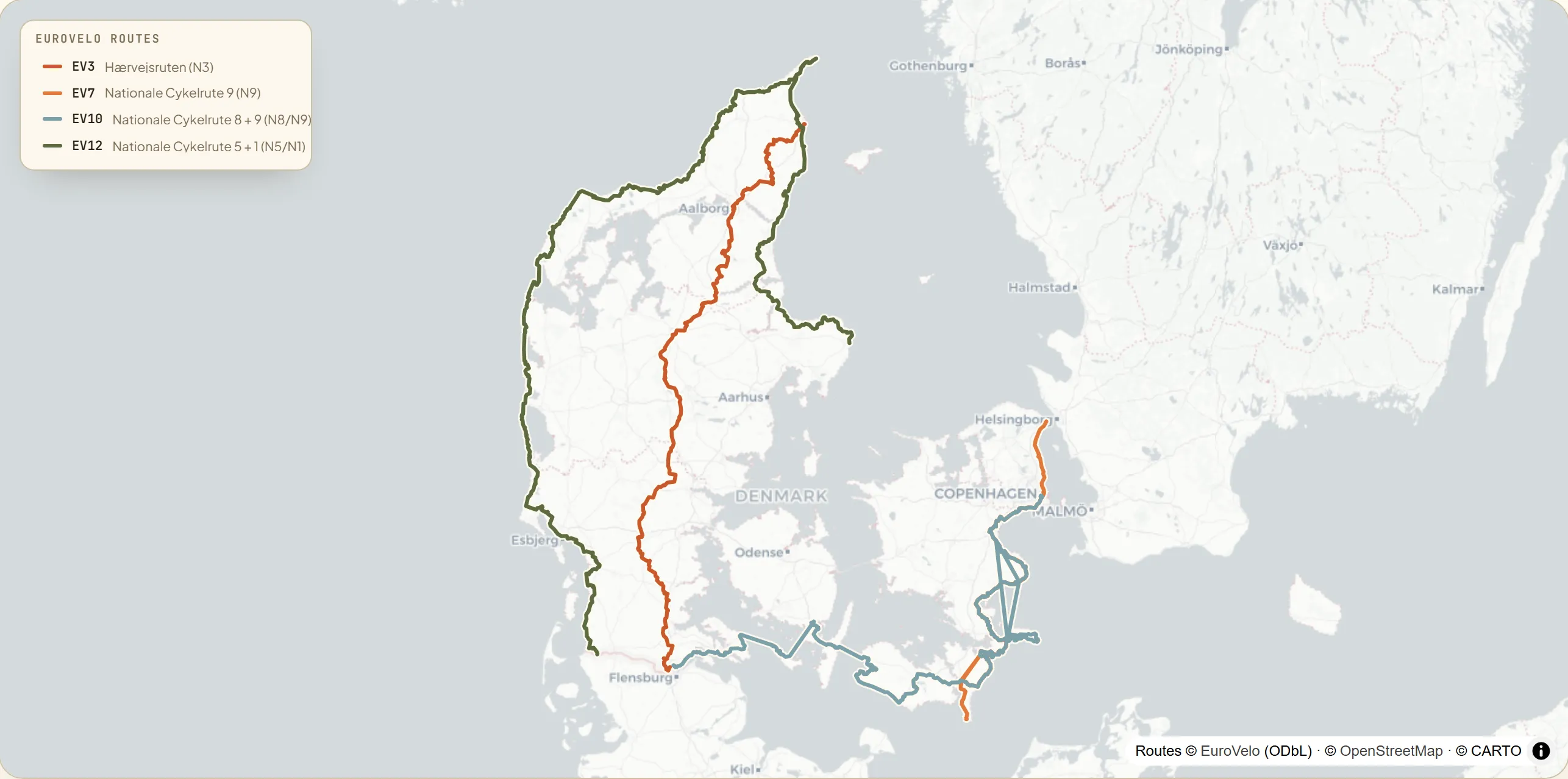
Map of Denmark with four signed EuroVelo routes — the Pilgrims Route (EV3) down the Jutland spine from Frederikshavn to the German border, the Sun Route (EV7) from Helsingør through Copenhagen to Gedser, the Baltic Sea Cycle Route (EV10) island-hopping from Sønderborg to Copenhagen, and the North Sea Cycle Route (EV12) up to Skagen and down the whole west coast to the German border.
4
national routes
~1,950 km
EuroVelo signed
~11,000 km
national cycle network
Why Denmark

Four EuroVelos on a flat, ferry-stitched country.

Four signed EuroVelos cross Denmark, every one co-signed on the Nationale Cykelruter — Denmark's national network of way-marked "N"-numbered cycle routes, around 11,000 km mapped on the official Ruter.dk platform. Denmark was a pioneer: the Hærvejsruten, its first national cycle route, opened in 1989 and is now EuroVelo 3.

The riding is flat to gently rolling on a dense web of dedicated cycleways and quiet lanes, stitched across the islands by bridge and bike-friendly ferry — the only real effort is the coastal wind. Denmark's standout for bikepackers is its national network of free nature campsites and shelters (shelterpladser), mapped on the government's udinaturen.dk portal.

The scenery spans the Skagen sandspit where two seas meet and the Thy dunes in the north, the UNESCO Wadden Sea and Ribe (Denmark's oldest town) on the west coast, the Viking-age Jelling mounds down the Jutland spine, the white chalk cliffs of Møn, and Kronborg castle on the Øresund before Copenhagen — repeatedly ranked among the world's best cycling cities.

The mapHover a route to trace it

Four EuroVelos across Denmark.

Denmark's four signed EuroVelos, clipped from the official GPX tracks. Hover a line or its legend entry to trace it — the Hærvejsruten down the Jutland spine, the Sun Route past Kronborg to Copenhagen, the Baltic island-hop over nine isles, and the long North Sea coast around Skagen — then tap through to the route.

Interactive map loads as you scroll
National & regional infoBackground, not booking

The bodies behind the network.

Denmark's cycle network is run by Danish Cycling Tourism (the EuroVelo coordination centre) and published on the national Ruter.dk platform, with the cyclists' federation and the tourist board behind the routes. It's here for context and credibility. No need to leave to plan: your route and every place to stay come together in the Bikepackia planner.

The routesTap a card to learn more

Four ways across Denmark.

The Jelling mounds on the Hærvejen
Photo: Szilas / Wikimedia Commons (CC0)

Pilgrims Route

Hærvejsruten (N3)FREDERIKSHAVNPADBORG

Denmark's first national cycle route — opened in 1989 — and its history spine, running the full length of Jutland north to south along the Hærvejen, the ancient ox-and-army road down the peninsula's watershed ridge. From Frederikshavn in the north it threads forest, heath and open country through Viborg to the UNESCO-listed Jelling mounds — the Viking royal burial mounds and rune stones called "Denmark's birth certificate" — and on to Padborg at the German border near Kruså. Easy: flat to gently rolling the whole way, no real climbs. EuroVelo states 449 km across Denmark.

449 km6–9 daysEasy
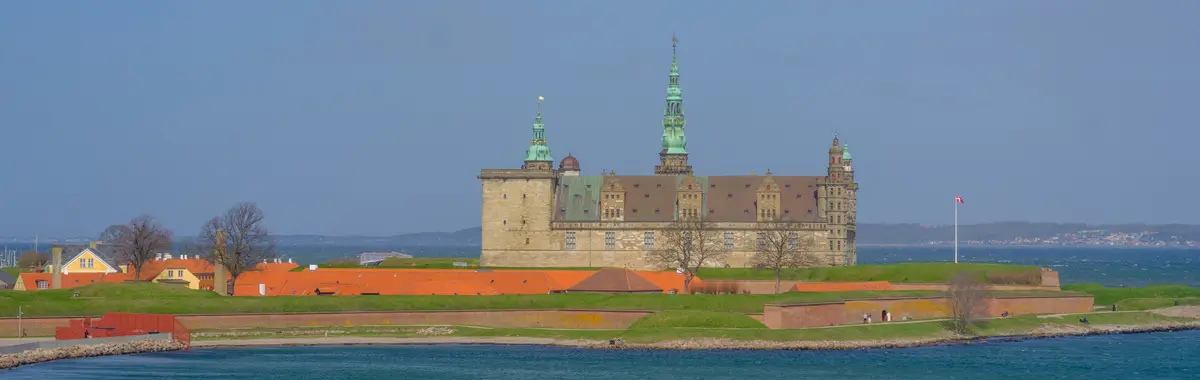
Kronborg Castle at Helsingør
Photo: ArildV / Wikimedia Commons (CC BY-SA 4.0)

Sun Route

Nationale Cykelrute 9 (N9)HELSINGØRGEDSER

The Øresund-to-Baltic ride down the east of Zealand and on to Falster, on Danish national route 9. From Helsingør in the north — where Kronborg, the Renaissance castle of Shakespeare's Hamlet, guards the narrow Øresund strait to Sweden — it runs south through Copenhagen, repeatedly ranked among the world's best cycling cities, past the Stevns and Møn chalk-cliff country and the Marielyst beaches to Gedser, the ferry port for Rostock in Germany and Denmark's southernmost point. Easy: flat cycleways and coast, no climbs. About 360 km across Denmark.

360 km5–8 daysEasy
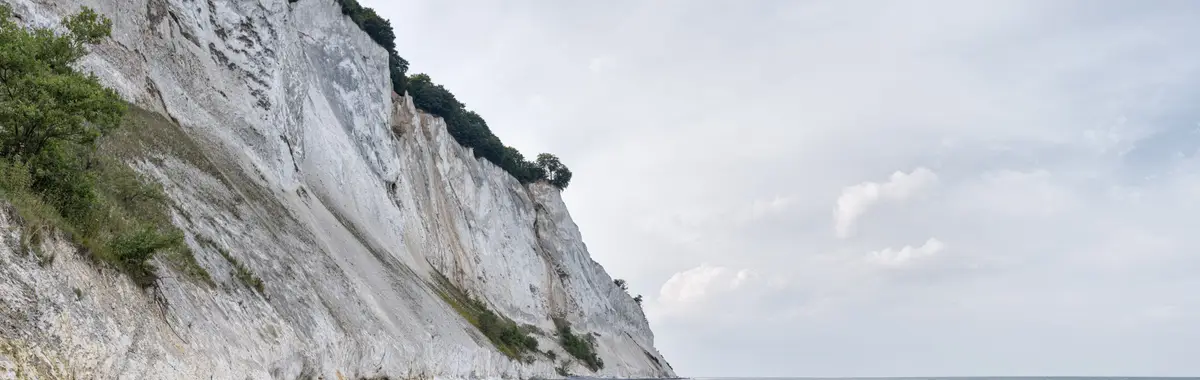
Møns Klint on the Baltic islands
Photo: Giorgio Galeotti / Wikimedia Commons (CC BY 4.0)

Baltic Sea Cycle Route

Nationale Cykelrute 8 + 9 (N8/N9)SØNDERBORGCOPENHAGEN

The great Danish island-hop — flat throughout, but ferry-dependent, so timetables set the pace rather than gradient. From Sønderborg and its harbour castle in south Jutland it joins the EuroVelo at the German border, then crosses to Als and works east over nine isles — Ærø, Funen, Tåsinge, Langeland, Lolland, Falster, Bogø, Møn — by bridge and bike-friendly ferry, past the white chalk cliffs of Møns Klint, before Danish national route 9 carries it into Copenhagen. Easy on gradient, with Baltic wind the only effort. EuroVelo states the Danish section is 360 km.

360 km6–9 daysEasy
Grenen at Skagen, where two seas meet
Photo: Tanya Dedyukhina / Wikimedia Commons (CC BY 3.0)

North Sea Cycle Route

Nationale Cykelrute 5 + 1 (N5/N1)GRENAAGERMAN BORDER

The long Jutland coastal loop and the toughest of the four — flat dune, marsh and dike coast, but 779 km with the open North Sea wind a constant. From Grenaa (the ferry arrival from Sweden) it runs north up the east coast on national route 5 to Grenen at Skagen, the sandspit where the Skagerrak and Kattegat seas meet at Denmark's northern tip, then turns south down the entire wild west coast on national route 1 — the Vestkystruten — past Thy National Park, the UNESCO Wadden Sea and Ribe, Denmark's oldest town, to the German border. Moderate: easy on gradient, long and exposed. EuroVelo states 779 km.

779 km11–15 daysModerate
Before you rideDenmark, the practical bits

What every bikepacker asks about Denmark.

Is wild camping allowed in Denmark?

Free-pitch wild camping — a tent anywhere on public land — is not allowed, and you can be fined. But Denmark is unusually bikepacker-friendly through two legal routes. A national network of free or low-fee nature campsites and shelters (shelterpladser) does let you pitch a tent — typically a maximum of one or two nights, no advance booking, and around a third of the sites carry a three-sided shelter; they're all mapped on the official udinaturen.dk portal. Separately, bivouacking — sleeping out without a tent, just a mat, bag or hammock — is permitted for one night in most state forests under the Nature Agency's open-access rules. Steer clear of signed dunes and beaches, private land without permission, and protected reserves.

Which season is best for bikepacking Denmark?

May to September, with June to August the warm peak — EuroVelo's Danish route pages give the recommended season as 1 May to 1 October. Denmark's climate is cool and maritime, so summer highs sit broadly around 18–22 °C and it's rarely hot; spring and early autumn are cooler at about 10–16 °C and quieter. Avoid November to March for cold, short, wet, exposed days. The year-round factor isn't hills but wind — frequent headwinds on the open North Sea (EV12) and the Baltic isles (EV10) are the real effort — and July is the domestic-holiday peak on the coasts.

Any cycling regulations I should know?

A few that matter. Helmets are recommended but not legally required at any age, and a hi-vis vest isn't mandatory. A roadworthy bike must carry reflectors — white at the front, red at the rear, and yellow reflectors on the pedals and wheels — and a working bell fixed to the handlebar is compulsory. After dark and in poor visibility you need a fixed (not handheld) white front light and red rear light, visible from at least about 300 metres. Ride on the right, use the marked cycle path or lane where one exists, and hand-signal your turns and stops. Typical cycling-offence fines run roughly 500–1,500 DKK (about €67–€200) — for example riding without lights after dark or using a handheld phone — so treat them as a guide and check current figures before you go.

What should I expect as a bikepacker in Denmark?

Four signed EuroVelos over a flat, compact country, all mapped onto the roughly 11,000 km national N-route network (the Nationale Cykelruter) published on Ruter.dk. Terrain is flat to gently rolling throughout — the only real effort is coastal wind off the North Sea and the Baltic. The overnight standout is the free nature-campsite and shelter network (shelterpladser, on udinaturen.dk), alongside campsites and hostels, with bivouacking legal in state forests; there's no France- or Germany-style cyclist-bed accreditation here, so the shelter network is the hook. Routes hop the islands by bridge and bike-friendly ferry — EV10 crosses nine isles, EV12 uses the Grenaa ferry from Sweden — so plan ferry timings. Danish trains carry bikes widely (DSB regional and intercity, plus the Copenhagen S-train) with a bike ticket, though long-distance services can need a bike reservation, so check current DSB rules. Resupply is excellent — Denmark is densely towned, with frequent supermarkets and bakeries even on the heath and the North Sea coast.

READY WHEN YOU ARE

Pick the route. We'll plan the rest.

Drop a EuroVelo into the Bikepackia planner and turn the line on the map into rideable days — surface-aware routing, elevation, water, food and a bed every night.