Atlantic Coast Route
La VélodysséeROSCOFF → HENDAYE
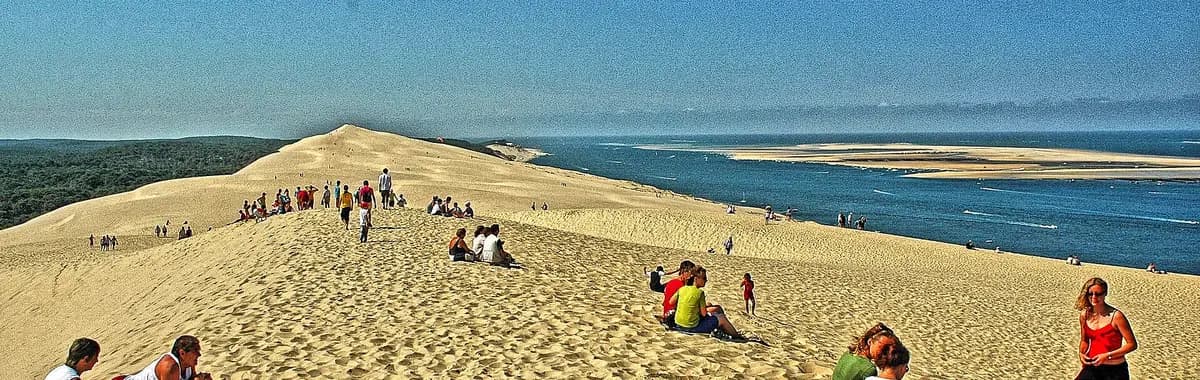
France's flagship coastal greenway. Pine forests, dunes and oyster ports from Brittany down to the Basque border — the most traffic-free EuroVelo in the country.
1,300 km14–20 days70%car-freeEasy
Seven signed EuroVelo routes cross France — ocean greenways, river paths and mountain descents. Explore each one, then send it straight to the planner.
France may be the most bike-touring-ready country on earth: more than 26,000 km of signed véloroutes, hundreds of car-free voies vertes laid over old railways and canal towpaths, and thousands of “Accueil Vélo” beds and cafés right on the route. La Loire à Vélo alone draws a million riders a year. Roll from Atlantic dunes to Provençal lavender — past Renaissance châteaux, Roman cities and Alpine rivers — mostly flat, fully waymarked, gentle enough for a first big tour.
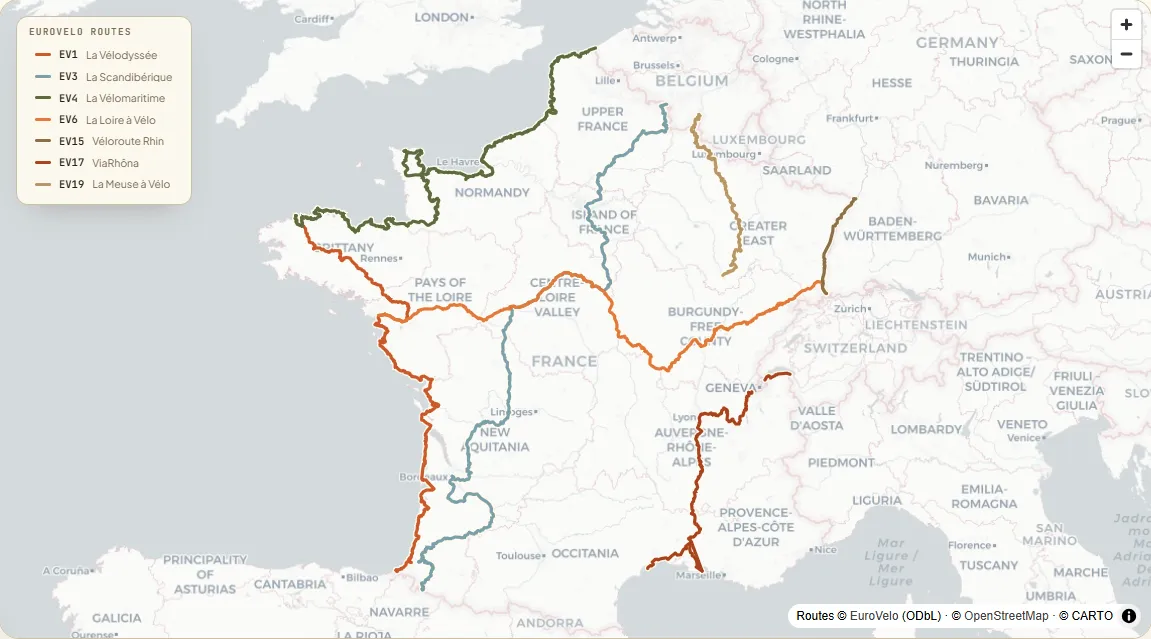
Every signed EuroVelo in France, drawn from the official GPX tracks. Hover a line or a legend entry to trace it end to end, then tap through to the route.
The national organisations that sign, map and accredit France's cycle routes — here for context and credibility. No need to leave to plan: your route and every place to stay come together in the Bikepackia planner.

France's national EuroVelo coordination centre since 2011 — a network of local authorities driving active mobility across the country.
Visit site →
The national cycling-tourism portal: every major route and greenway, trip-planning tools and practical advice for riding France.
Visit site →
A national accreditation scheme guaranteeing cyclist-ready beds, rentals, repairs and cafés within reach of the route.
Visit site →France's flagship coastal greenway. Pine forests, dunes and oyster ports from Brittany down to the Basque border — the most traffic-free EuroVelo in the country.
The longest EuroVelo in France. A diagonal pilgrim line from the Belgian border through Paris and the Loire down to the Pyrenees — cathedrals, canals and quiet farm roads.
The English Channel coast end to end — Breton headlands, Mont-Saint-Michel bay, the D-Day beaches and the white cliffs of the Côte d'Albâtre up to the Belgian border.
France's best-loved river ride. Follow the Loire past Renaissance châteaux and vineyards, then the canals of the Centre and the Doubs across to the Rhine at Basel — flat, paved and gentle the whole way.
The French bank of the Rhine through Alsace — flat, fully paved and almost entirely traffic-free, linking Strasbourg's waterways to the vineyards above Basel.
From the shores of Lake Geneva to the Mediterranean, the ViaRhôna shadows the Rhône downstream past Lyon, Roman Provence and the lavender south — a gentle, mostly downhill descent to the sea.
Trace the Meuse from its source on the Langres plateau down through the battlefields of Verdun and the wooded gorges of the Ardennes to the Belgian border at Givet.
Mostly no, with one big exception. Camping sauvage — pitching for several days — is forbidden by default. Bivouac — a small tent for a single night, up roughly dusk to dawn — is tolerated wherever it isn't explicitly banned, and that's how most bikepackers sleep out. It's banned on beaches and the coast, beside roads, within 200 m of a drinking-water source, within 500 m of a listed monument, and in nature reserves and national-park core zones; in the mountains it's allowed above ~1,500 m in the Alps and ~1,000 m in the Pyrenees. On private land, ask the owner. France is dense with campsites and Accueil Vélo beds, so a legal pitch is rarely far.
Late spring and early autumn — roughly April to June and September to October. Temperatures sit around 15–22 °C, the routes are quiet, and you dodge the July–August heat and crowds. The south (ViaRhôna, the Mediterranean) bakes in midsummer, so ride it in the shoulder seasons; high mountain passes in the Alps and Pyrenees only clear of snow from mid-May to September.
A few that catch tourers out. A certified reflective vest is mandatory outside towns at night or in poor visibility, and front (white) and rear (red) lights are required after dark — reflectors are compulsory day and night. Helmets are mandatory only for under-12s but sensible for everyone. Your bike needs working brakes and a bell, headphones are banned while riding, and you follow the same rules as drivers, riding on the right. Fines for slipping up run from about €22 to €135.
One of the most cycle-ready countries going. The signed network runs to roughly 26,000 km, much of it on car-free voies vertes, and the Accueil Vélo label marks beds and cafés geared to riders right on the route. Bikes ride free on regional TER trains, though a growing number of regions require a (cheap or free) bike reservation in summer — check the Vélo à Bord platform. Food, water and a bed are easy to find on the flagship routes; provision thins out on quieter corridors, so plan resupply on remote days.
Drop a EuroVelo into the Bikepackia planner and turn the line on the map into rideable days — surface-aware routing, elevation, water, food and a bed every night.