
Bikepackia
EuroVelo · Poland

Ride Poland, coast to Carpathians.

Six signed EuroVelos cross Poland — the flat Baltic coast as Trasa Velo Baltica, the Capitals Route to the primeval Białowieża Forest, the amber line down the Vistula from Gdańsk, and the East Europe spine that climbs into the Carpathians. Explore them, then send one straight to the planner.

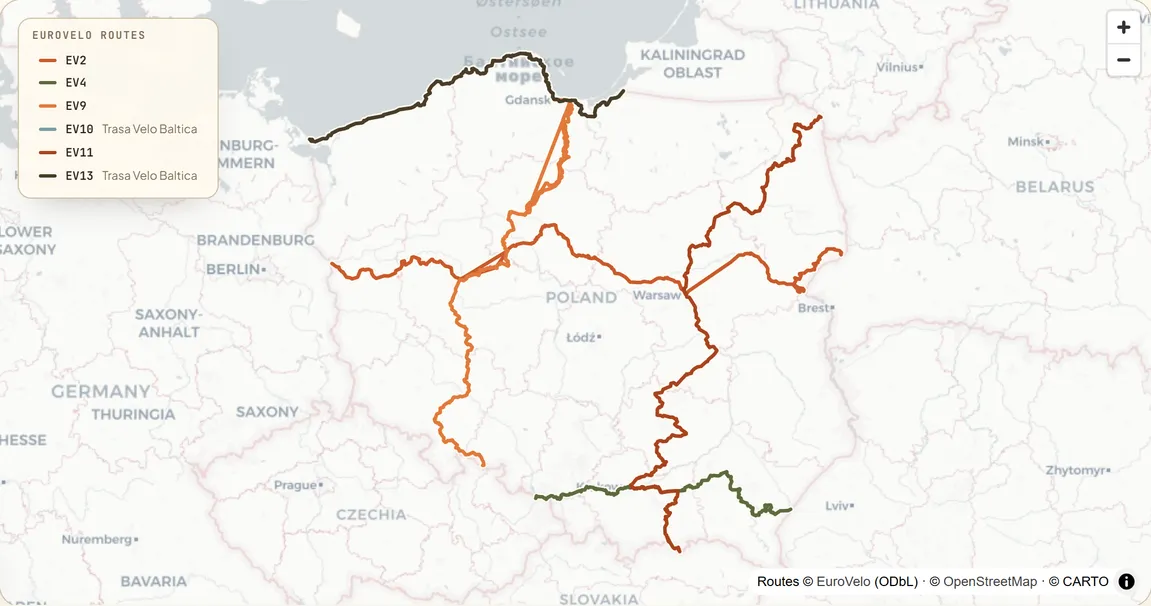
Map of Poland with six signed EuroVelo routes — the Capitals Route (EV2) west to east across the central plains, the Central Europe Route (EV4) through Wrocław and Kraków along the south, the Baltic–Adriatic (EV9) from Gdańsk down to the Czech border, the Baltic Sea Cycle Route (EV10) and the Iron Curtain Trail (EV13) co-signed as Trasa Velo Baltica along the whole coast, and the East Europe Route (EV11) down the north-south spine into the Carpathians.
6
national routes
~5,000 km
EuroVelo signed
~2,000 km
Green Velo trail
Why Poland

Poland is a young, fast-growing EuroVelo country, coast to mountains.

Its six EuroVelo routes total around 5,000 km and have been coordinated since September 2025 by the National EuroVelo Coordination Centre (Narodowe Centrum Koordynacji EuroVelo), run by the Polish Tourism Organisation with the Association of Voivodeships. The network is uneven but improving fast — coastal greenways and dike paths on the Baltic, river-valley cycleways along the Vistula and the Oder, purpose-built regional networks, and long stretches of quiet minor road.

The cyclist-welcome label to look for is Miejsce Przyjazne Rowerzystom ("Cyclist-Friendly Place"), a regional accreditation of bike-friendly accommodation and cafés, pioneered on Green Velo — Poland's longest single signed trail at around 2,000 km across the five eastern regions, with roughly 230 cyclist service points.

The scenery spans the Baltic dunes and the shifting Słowiński sands near Łeba, the Masurian and Suwałki lake country, the primeval Białowieża Forest with its European bison, Renaissance Kraków and Wawel Castle on the Vistula, and the Carpathian Dunajec gorge in the Pieniny.

The mapHover a route to trace it

Six EuroVelos across Poland.

Poland's six signed EuroVelos, clipped from the official GPX tracks. Hover a line or its legend entry to trace it — the Baltic coast co-signed as Trasa Velo Baltica, the Capitals Route to the Białowieża Forest, the amber line from Gdańsk, and the East Europe spine into the Carpathians — then tap through to the route.

Interactive map loads as you scroll
National & regional infoBackground, not booking

The bodies behind the network.

The national organisations that coordinate, sign and map Poland's cycle routes — here for context and credibility. No need to leave to plan: your route and every place to stay come together in the Bikepackia planner.

The routesTap a card to learn more

Six ways through Poland.

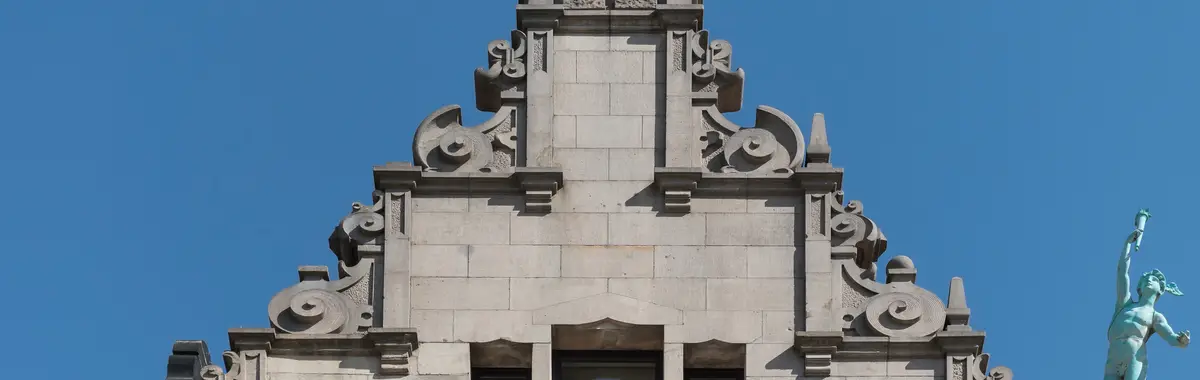
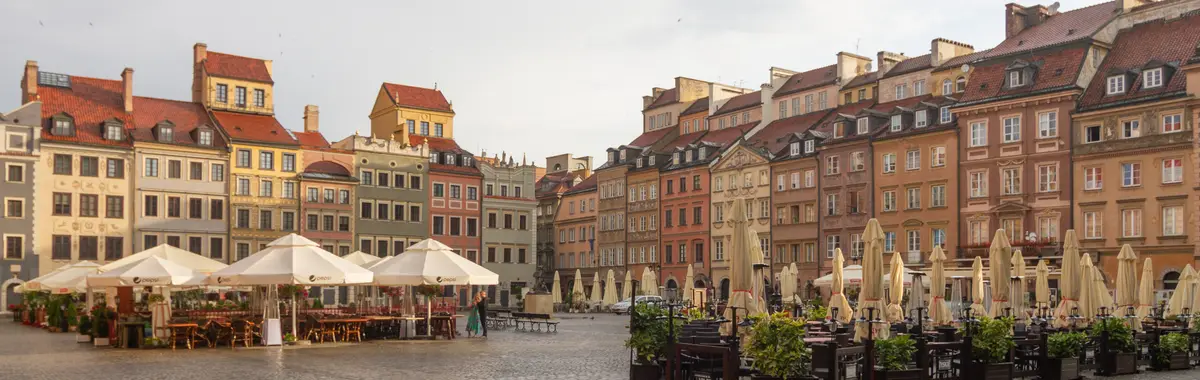
Warsaw's Old Town Market Square
Photo: Maksym Kozlenko / Wikimedia Commons (CC BY-SA 4.0)

Capitals Route

KOSTRZYN NAD ODRĄ (GERMAN BORDER)BIAŁOWIEŻA (BELARUSIAN BORDER)

The full west-to-east capitals traverse — German border to the primeval Białowieża Forest. From Kostrzyn nad Odrą on the Oder it crosses the Wielkopolska plains through Poznań, reaches the Vistula at Włocławek, runs through Warsaw, then heads east across Mazovia and Podlasie to Białowieża, the last lowland primeval forest in Europe and home to wild European bison. Largely flat-to-rolling the whole way — the difficulty is the distance, not the climb. EuroVelo gives the Polish route as approximately 1,190 km.

1,190 km14–18 daysModerate
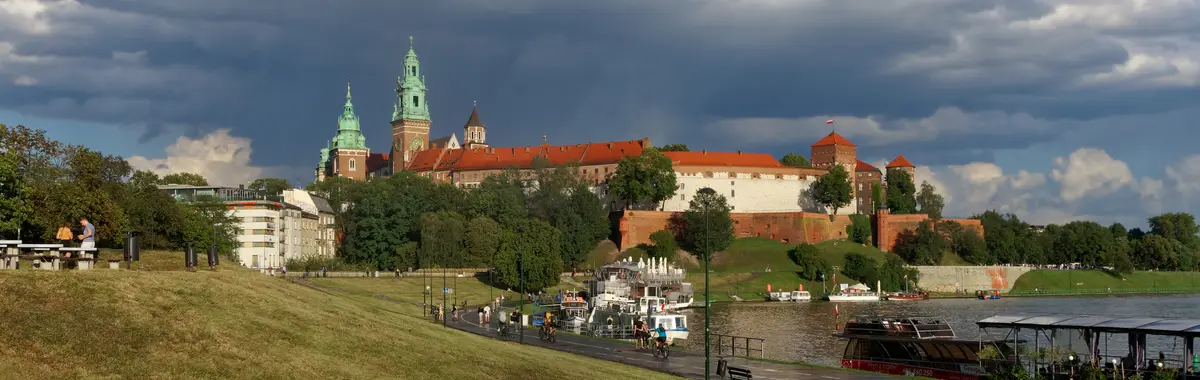
Wawel Castle on the Vistula, Kraków
Photo: Jakub Hałun / Wikimedia Commons (CC BY-SA 4.0)

Central Europe Route

ZGORZELEC (GERMAN BORDER)KORCZOWA (UKRAINIAN BORDER)

The southern cross-country ride — German border to Ukraine, exiting east, not south. From Zgorzelec it runs across Lower Silesia through Wrocław and Opole, reaches the Vistula and Renaissance Kraków with its UNESCO Old Town and Wawel Castle, then continues through Rzeszów to Korczowa on the Ukrainian frontier. Mostly flat-to-rolling river-and-plain riding, with gentle uplands toward the south-east. EuroVelo publishes no km figure for the Polish EV4; the geography across the whole south is around 900 km — owned here as an estimate.

900 km11–15 daysModerate
Wrocław's Market Square
Photo: Jacek Halicki / Wikimedia Commons (CC BY-SA 4.0)

Baltic – Adriatic

GDAŃSK (BALTIC COAST)GŁUCHOŁAZY (CZECH BORDER)

The flat, family-friendly amber line — Baltic coast to the Sudety mountains. From Gdańsk it follows the Lower Vistula Valley south through Inowrocław to Poznań, then crosses to the Odra and Wrocław before climbing gently to the Czech border at Głuchołazy in the Sudety. EuroVelo calls the Polish section one of the flattest segments of the whole route — ideal for families, with limited traffic and rideable surfaces, and gentle hills only at the Sudety end. The Polish EV9 is 534 km.

534 km7–9 daysEasy
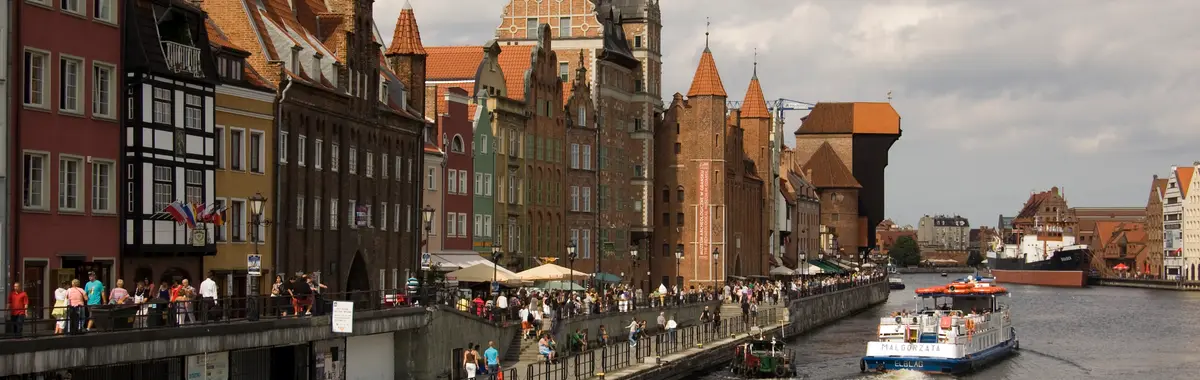
Gdańsk waterfront and the Żuraw crane
Photo: Aussteiger21 / Wikimedia Commons (CC BY-SA 3.0)

Baltic Sea Cycle Route

Trasa Velo BalticaŚWINOUJŚCIE (GERMAN BORDER)BRANIEWO (RUSSIA BORDER)

The whole Polish Baltic coast, signed as Trasa Velo Baltica (the West Pomeranian / Baltic coast cycle route). From Świnoujście on Wolin island it runs east through Międzyzdroje, Kołobrzeg, the Słowiński shifting dunes near Łeba, the Tricity of Gdynia, Sopot and Gdańsk, then on through Elbląg to Braniewo near the Russian/Kaliningrad border. Largely flat coastal riding, never far from the seashore — the only effort is distance and the odd headwind. The full Polish coast is about 582 km.

582 km8–11 daysEasy
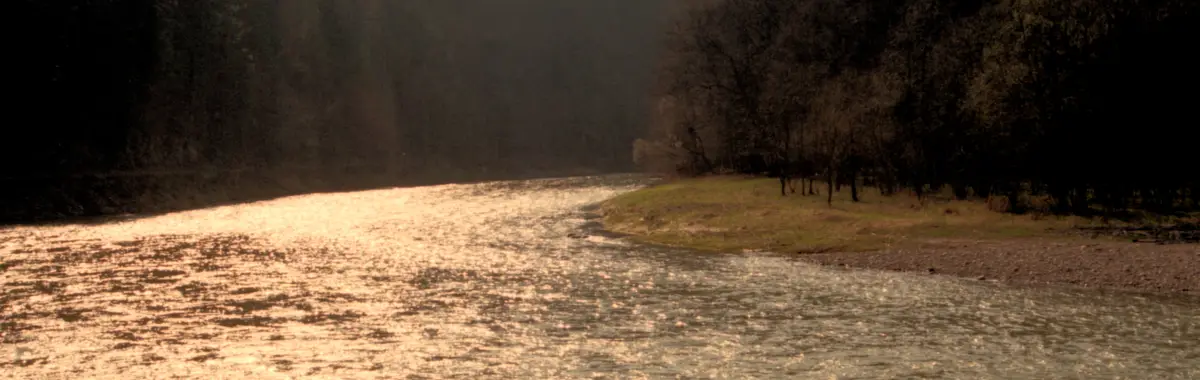
The Dunajec gorge in the Pieniny
Photo: Michal Valach / Wikimedia Commons (CC BY-SA 4.0)

East Europe Route

BUDZISKO (LITHUANIAN BORDER)MUSZYNA (SLOVAK BORDER)

The long north-south spine — Lithuanian border to the Carpathians. From Budzisko it runs through the Suwałki lakes and Białystok, down through Warsaw and Kraków, then climbs the hilly Carpathian Poprad valley to the Slovak border near Muszyna. Flat through the lake country and the central plains, then genuinely hilly and scenic south of Kraków where it enters the mountains — the Małopolska leg is signed VeloNatura. EuroVelo gives the Polish EV11 as 762 km.

762 km10–13 daysModerate
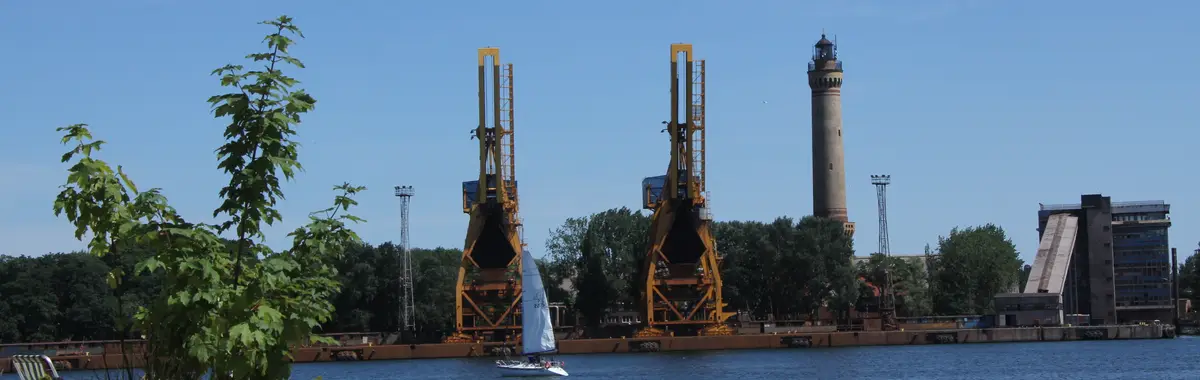
Świnoujście lighthouse on the Baltic
Photo: Nicola / Wikimedia Commons (CC BY-SA 4.0)

Iron Curtain Trail

Trasa Velo BalticaŚWINOUJŚCIE (GERMAN BORDER)BRANIEWO (RUSSIA BORDER)

The Polish Iron Curtain leg is the flat Baltic coast — co-signed with EV10 as Trasa Velo Baltica the whole way. From Świnoujście on the German border it follows the same West Pomeranian and Tricity itinerary as EV10 to Braniewo near the Russian/Kaliningrad border, with Cold-War history along the route — the Solidarity shipyards in Gdańsk most of all. Easy, flat coastal riding throughout (the full international EV13 is hard, but the Polish section is the coast). It shares EV10's ~582 km Polish distance.

582 km8–11 daysEasy
Before you ridePoland, the practical bits

What every bikepacker asks about Poland.

Is wild camping allowed in Poland?

Not in the general sense. Pitching outside designated sites (dziki kemping) is forbidden in national parks, nature reserves, on dunes and beaches, and on private land without the owner's permission — fines run up to roughly €120 (a few hundred złoty) per person. The legal way to sleep out is the Lasy Państwowe (State Forests) scheme "Zanocuj w lesie" ("Sleep in the Forest"): since 2021 over 425 designated forest areas allow tent, tarp or hammock bivouac — maximum two nights in one spot, fires only in marked places, leave no trace, and groups of ten or more must register with the local forest district. That, campsites and cyclist-friendly hosts are the bikepacker's options.

Which season is best for bikepacking Poland?

May to September, with late May–June and September the sweet spot — mild temperatures, long daylight, less rain and fewer crowds. High summer (July–August) is warmest at around 25–30 °C but brings the most rainfall and peak prices on the Baltic coast and in Kraków. Spring and early autumn are cooler (about 10–18 °C) and quieter, good for the flat river and coast routes. Avoid November–March — cold, short days and snow, which lingers later in the Carpathians at EV11's southern end. The Baltic coast and flat river routes ride well all of May–September; the Carpathian south of Kraków is best June to September.

Any cycling regulations I should know about?

A few worth knowing. Helmets are not mandatory for adults (recommended), and a reflective vest isn't required — note that a helmet rule for riders under 16 is due from 2026, so verify before you go. Lights are required from dusk to dawn and in poor visibility: a white front light and a red rear light (steady or flashing), plus a red rear reflector, all visible from at least 150 m; daytime riding without lights isn't fined, but your bike must have at least one working brake and a bell. Ride on the right and use the cycle path when one is provided for your direction. Cycling is an offence at 0.5 ‰ blood alcohol, with drunk-cycling fines from around 500 złoty and equipment fines up to about 500 złoty.

What should I expect as a bikepacker in Poland?

Six signed EuroVelos totalling around 5,000 km plus the ~2,000 km Green Velo trail — a young, fast-improving network coordinated since 2025 by the National EuroVelo Coordination Centre (the Polish Tourism Organisation with the Association of Voivodeships). Terrain is mostly flat-to-rolling — the Baltic coast, the Vistula and Oder valleys, the central plains — with Carpathian hills only south of Kraków on EV11. The cyclist-welcome label is Miejsce Przyjazne Rowerzystom (region-led on Green Velo, West Pomerania and Małopolska). Bikes ride regional Polregio trains with a cheap flat bike ticket and usually no reservation; long-distance PKP Intercity needs a bike ticket and a compulsory bike-space reservation, so book ahead in summer. Resupply is good — Poland is densely towned, with Żabka and Biedronka shops, bakeries and pensjonaty close-spaced.

READY WHEN YOU ARE

Pick the route. We'll plan the rest.

Drop a EuroVelo into the Bikepackia planner and turn the line on the map into rideable days — surface-aware routing, elevation, water, food and a bed every night.