


Bikepackia
EuroVelo · Portugal

Ride Portugal, Minho to Sagres.

One signed EuroVelo runs the entire Portuguese coast — EV1, the Atlantic Coast Route, from the Minho border to Europe's south-west tip. Explore it, then send it straight to the planner.

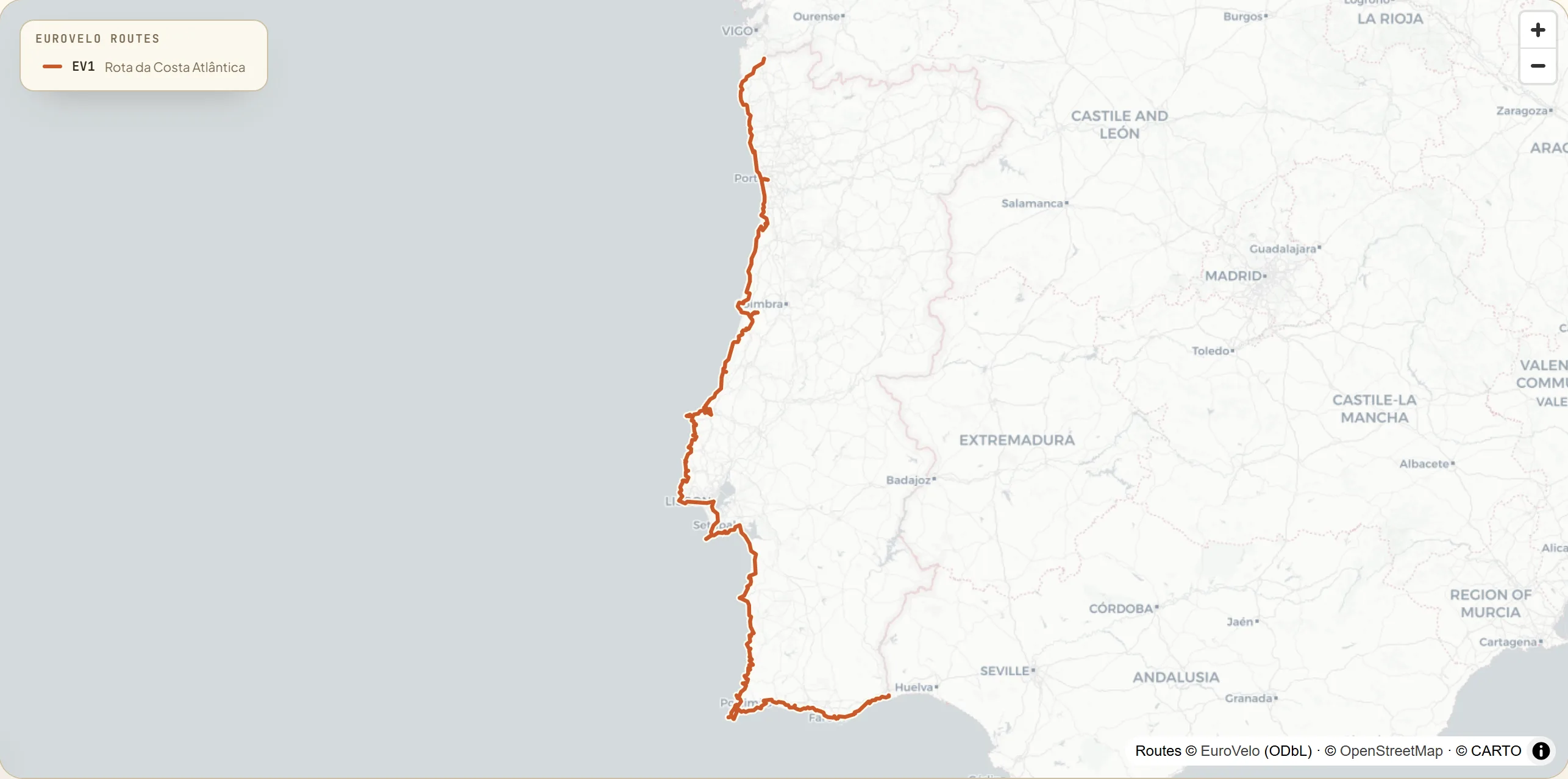
Map of mainland Portugal with the single signed EuroVelo route — EV1, the Atlantic Coast Route — drawn down the full Atlantic coast from Caminha in the north to Sagres in the south-west.
1
national route
1,150 km
EuroVelo signed
18 stages
coast to coast
Why Portugal

One coast, end to end, in the sun.

Portugal’s signed EuroVelo route is EV1, the Atlantic Coast Route (Rota da Costa Atlântica), a 1,150 km journey divided into 18 stages that follows the country’s Atlantic shoreline from north to south. As the flagship route of Portuguese Trails, it links many of Portugal’s most iconic coastal landscapes and cultural centres.

The traffic-free backbone is provided by a growing network of ecovias — greenways that often follow disused railway corridors — with particularly strong coverage in the Centro region and along the Algarve’s 214 km Ecovia do Litoral. These routes offer some of the country’s most enjoyable and accessible cycling.

Along the way, riders pass through the lush Minho region around Caminha, the historic city of Porto and the Douro estuary, the lagoons of Aveiro, the surf beaches of Nazaré, and the vibrant streets of Lisbon before reaching the wild coastline of the Costa Vicentina and the dramatic cliffs of Sagres. With more than 300 days of sunshine a year in southern Portugal, it is one of Europe’s most rewarding coastal cycling routes.

The mapHover the route to trace it

The Atlantic Coast Route, end to end.

Portugal's one signed EuroVelo, clipped from the official GPX track to the mainland. Hover the line or the legend entry to trace it from Caminha to Sagres, then tap through to the route.

Interactive map loads as you scroll
National & regional infoBackground, not booking

The bodies behind the network.

The national organisations that coordinate, sign and map Portugal's cycle routes — here for context and credibility. No need to leave to plan: your route and every place to stay come together in the Bikepackia planner.

The routeTap the card to learn more

One way down Portugal.

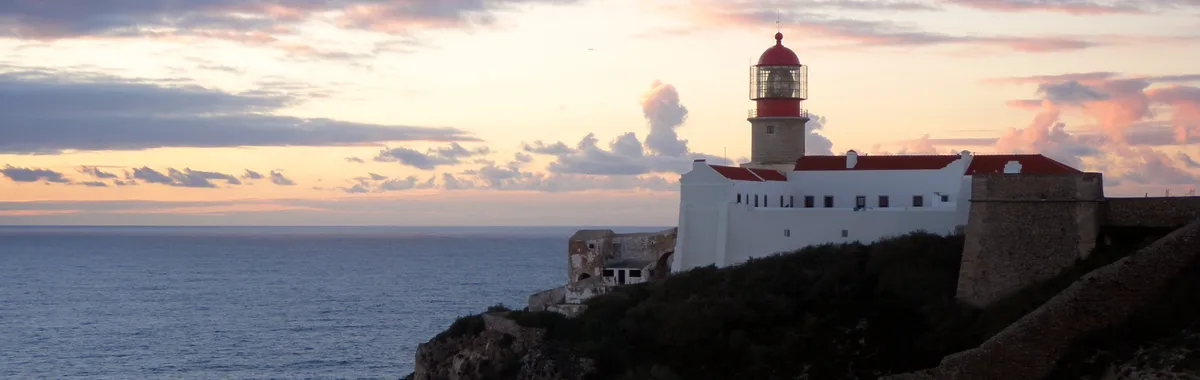
Cabo de São Vicente lighthouse, Sagres
Photo: Pentarux / Wikimedia Commons (CC BY-SA 2.0)

Atlantic Coast Route

Rota da Costa AtlânticaCAMINHASAGRES

Portugal's single, sun-drenched Atlantic spine and the only signed EuroVelo in the country. From the green Minho border at Caminha, past Porto and the Douro estuary, the Aveiro lagoon and the dunes, the big-wave cliffs of Nazaré, Lisbon and Sintra, then the wild Costa Vicentina to Cabo de São Vicente at Sagres — the south-westernmost point of mainland Europe. Flattish but long and windy, on a mix of ecovia greenway and quiet road. Over 300 days of sunshine a year on the Algarve leg.

1,150 km14–18 daysModerate
Before you ridePortugal, the practical bits

What every bikepacker asks about Portugal.

Is wild camping allowed in Portugal?

Largely no. Wild camping (campismo selvagem) is heavily restricted and there's no blanket bivouac right — the rules tightened after 2021. It's strictly forbidden in protected areas: Parques Naturais, Natura 2000 sites, the coastal protection strip and beaches, with enforcement hardest in the Algarve, the Lisbon area and the national and nature parks. Campervans may stop a maximum of 48 hours in one spot only if IMT-approved and showing no camping behaviour. Fines run from roughly €30 to €600 generally, and up to €2,000 in nature reserves. Outside protected zones each município sets the rule, so use campsites or paid private-land schemes to be safe.

Which season is best for bikepacking Portugal?

Spring (March–May) and autumn (September–October) are best overall — mild at around 18–26 °C and quieter on the coast. Avoid July and August in the Alentejo interior and the Algarve, where it regularly tops 30 °C and the coast is at its most crowded. The regions split: the north — Minho and Porto — is cooler, wetter and windier, and the most comfortable summer option, while the Algarve and the south ride beautifully from October to April with 300-plus days of sunshine.

Any cycling regulations I should know about?

A few worth knowing under the Código da Estrada. A helmet is mandatory only for under-16s — for adults it's advised but not required (a 2026 bill to extend it to all riders is under discussion, not yet law). At night or in poor visibility you need a white front light and a red rear light, and reflective clothing is strongly recommended. No phone use while riding, even hands-free. Ride on the right and use bike lanes where present. Fines run from roughly €30 to €250.

What should I expect as a bikepacker in Portugal?

One signed EuroVelo — EV1, 1,150 km over 18 stages — plus the independent Rede Nacional de Cicloturismo (~6,400 km of low-traffic roads and GPS tracks). The traffic-free backbone is the ecovias greenways, strongest in the Centro region and the Algarve's 214 km Ecovia do Litoral; expect a mix of greenway and quiet road, since EuroVelo publishes a development-status legend rather than a car-free %. There's no national cyclist-welcome label — FPCUB and euroveloportugal.com are the support hubs. Bikes ride free on CP trains (one per passenger, space permitting), though Intercidades effectively needs a reserved bike spot. Resupply is dense along the populated Porto–Aveiro–Lisbon–Algarve coast and thinner and hotter on the wild Costa Vicentina, so carry water there.

READY WHEN YOU ARE

Pick the route. We'll plan the rest.

Drop a EuroVelo into the Bikepackia planner and turn the line on the map into rideable days — surface-aware routing, elevation, water, food and a bed every night.